Wednesday, July 28, 2010

Three Things Women do Wrong


By Greg Brynelson Certified Rolfer®, RN
7/28/2010

#1. Carry a heavy purse on one shoulder.

It’s big, it’s heavy, it has all your stuff for the day in it, and it’s throwing off your shoulders. As a Rolfer I constantly see women with one shoulder hiked up and frozen in this position. In fact many women can no longer even carry a purse on the opposite shoulder their body is so organized around holding up the purse carrying one..

The alternative: Get an across the body strap or wear a backpack.


#2. Wear high heels daily.

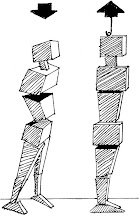
I know that couple extra inches under your heels make your legs look longer, your butt stick out and your chest too, but daily wearing of heels throws off your center of gravity and messes with the foot/calf structure. It doesn’t allow for full articulation of the foot on the ground, jams the toes to a point, and shortens calf muscles. Not to mention, your lumbar spine is thrown into a sway and your body organizes backwards – as if you’re walking downhill all day.

The alternative: Shorter heels, wider heels, or just simple supportive shoes that have no lift.


#3. Talk on a phone for work.

If you answer the phone for a living and don’t wear a headset you’re not alone. I see a lot of women with jammed up necks and shoulders from trying to hold onto the phone throughout the day. Not only does this make multitasking harder, it creates a pattern of usage that over time leads to neck and shoulder imbalance.

The alternative: wear a headset or go speakerphone.


These are all observations from my Rolfing practice of over 7 years in San Francisco’s Financial District. I work with many people to assess their posture patterns and release the deep holdings carried within the body.

If you would like a free consultation, or to find out more about Rolfing visit my website today:


www.cityrolfer.com


Coming soon: “3 Things Men do Wrong”

Tuesday, May 4, 2010

Unconscious Postural Influences


by Greg Brynelson (5/4/2010)

"Do you watch peoples posture all the time?" When people grasp what I do for a living this is often a question I get.

When I first began training for Rolfing (R), I'll admit I was a chronic posture observer. What I've found true over time is that often there are distinct, visible, unconscious cues between related people. In fact it is so dramatic - if you're looking for it you can find them yourself. You need no special training. Airport layovers are my favorite time to do this but a busy sidewalk in downtown S.F. or the mall are also good places to begin your study of the way people move and stand. Watch how people who are together (family/ friends/ colleagues) are similar or different in the way they move and express.

You may see a a husband and wife with the same carriage in shoulders and pelvis, the same tucked under buttocks, or the same chin-forward position. Or sometimes where one spouse moves well, the other moves poorly. Does this make one dominant - or make the other a passive controller? I wonder. I often wonder if mates shape each-others postural habits, or whether we just pick mates that move like we do. I imagine it's a bit of both - we learn to speak and adopt each others body language.

A very distinct impression of this unconscious posture - I've noticed - is in relations of child to parent. In the most dramatic cases where a parent has a limp or severe scoliosis, I've seen that the child takes on this habit (limp, or shoulder distortion). While the child is perfectly healthy, he mimics parent's abnormality.

In my travels (to India, Thailand, Australia) I have also noticed that different cultures and even genders within the cultures move differently. In India men move quite uprightly, have fairly narrow personal space bubbles, and are quite flexible in the hips but always seem to be holding onto back of the scapulae. American's men often move forward by pushing their shoulders and stiff hips into the space directly in front of them (not thinking about the entire 360 degrees that the body occupies) and have wider "personal space bubbles" around them. These are just examples and broad generalizations, but they are distinct and noticeable from culture to culture.

Because of this unconscious connection of movement from one individual to the next, I believe Rolfing (R) can be a positive experience for the entire human family; when one person begins to have more freedom in his or her body, it can allow other members to also feel that freedom, and unconsciously adopt that new movement pattern. In the case of parent to child this seems especially valuable. In fact Rolfing can be evolutionary in this way (Ida Rolf would be proud I'm saying this right now). Obtaining fluidity, balance, and awareness in our own body we end up shaping not only our selves, but our family, friends, and broader culture at the same time.

So I next time you look in the mirror think about your own parents, how do you look like them?
Take a few minutes to look at the people around you how are you similar in the way you move, how are you different? It's fun, and can be enlightening - or even slightly disturbing (whatever your mindset). Does my dog really walk like me too?

Thursday, May 7, 2009

Detoxing "Detox" Diets


Being a registered nurse, and Rolfing(R) practitioner I am an advocate for healthy weight maintenance and healthy habits in general. However, I am always skeptical of practitioners promoting "detox" as a quick way to get healthy. It seems "detox" is a catch-all phrase for making a sudden healthy shift in eating, or doing a low calorie fast (like the popularized lemon juice/maple syrup one). However, it has very little basis in the Western medical approach.

Detox is really a misnomer. We all posses kidneys, intestines, and a liver. When these organs function properly, our body rids itself of waste. The idea that adipose tissue (fat) holds onto all these creepy, garbage-like chemicals offends my critical thinking abilities. Nothing I've read in my studies of medicine has convinced me I should jump on board the "detox" wagon - largely promoted in the yogic and naturopathic community. Until someone can inform me otherwise, I'm calling detox diets a magical way of describing the real positive benefits felt when one fasts for a time or changes dietary habits to ones that fit into the traditional food pyramid (no new news there). Can you measure the toxins leaving the system? Have heavy metals really eaten away inside you for years? Is your body in dire need of alkalizing agents? Is your colon REALLY packed with layers upon layers of caked-on feces?

Bah! Why don't we just fess up and call it eating healthy and getting exercise?

Thursday, April 30, 2009

Bonsai Grower


As a tree grows it bends, twists, branches, spreads, bows, and lifts through a complex interplay with the environment. The tree is affected by sunlight, wind, and available nutrients. Thus, the current form of the tree expresses a life with a rich and sorted history, not just the current best position for the tree. This is what happens in the human body.

The muscles, fascia, ligaments, and bones adapt to the environment throughout life. Hence, the current form is resultant of years of parenting, sports, work, emotion, injury, fatigue, eating habits, high heels, etc. and all of these factors influence the current form and shape of the physique. Unlike a tree, humans also consciously conform our bodies to fit certain socio/cultural cues - like holding our heads high, pulling our shoulders back, or tucking our guts.

Just like a Bonsai grower lovingly prunes and and artistically bends his trees into beautiful forms, a Rolfer(R) examines your physical history and body-story and over a series of sessions works to shape you by releasing the old stuck tissues, to shape the hisstory of pain, disarray, and crookedness, in order to help create a new, more vibrant form.

Thursday, March 12, 2009

Information-itis


Yes, I'm coining a new disease:

The overloading of oneself with information to the detriment of emotional and/or physical well being.

I say this with some conviction due to recent experiences managing my own life in the information age and working for many years with clients in the Financial District. I started asking, "How do I, and others, get wrapped up in information, communication, and entertainment to such a large degree?" For many it is essentially a full-time job, or simply synonymous with living in this age. Now don't get worried, I'm not in need of counseling yet but I've noticed that this behavior can be a slippery slope and many of us are participating in this behavior to a shocking degree with less productivity, increasing physical ailment, and disconnection from Nature as a result. At it's worst it can become an addiction - i.e. to the news, interntet, e-mail.

I think it's enough that most people are required to spend 8 hours/day working on a computer; to go home and fix oneself to yet another screen - be it a home computer, fancy cell phone
(Blackberry, iPhone), or TV serves to cause deep unrest in the body and mind. Besides the poor posture and deleterious micro-movements of mousing, typing, and Black-Berrying that this information managing creates in the physical body, it also removes us from the present reality of our surroundings, and can end up consuming more of our precious time (and yes our time here is finite).

I do recognize that these devices for communication and entertainment are simply a fact of modern life, but the way we choose to utilize them can contribute or detract greatly to our well-being. We need to make these devices work for us, not the other way around. It is a thin boundary to utilizing a technological device and being wrapped up in it.

Here are some suggestions, I invite you to adopt any that resonate with you:

1. Focus on improving the quality of communication and be an advocate of this in the workplace. Get it settled in one conversation instead of ten emails or text messages.

2. Be present and commit to do just one thing while you are doing it rather than switching between multiple tasks at the same time.

3. Set up regular time to simply be in your body (i.e. exercise, walking, regular stretch breaks from the computer, getting Rolfing ;-)).

4. Fast. Take the devices and shut them all off for a period of time (i.e. all of Saturday, or even just a few hours) and do something rewarding by yourself, with another, or in Nature.

5. Choose and filter entertainment. Media (music/TV/movies/net surfing/texting) can give us a fix, just like a drug and we have to choose carefully which drugs we consume with our eyes and ears. Media can create a mental reality that is fantastic but has absolutely no relation to our lives.

All the best!
-Greg

Thursday, January 15, 2009

The Pain Game

"Why is Rolfing so painfull?" When I see a new client I often hear about Rolfing's painfull repuatation. This may be due to the nature of the therapy, people's expectations around Rolfing, and the communication that happens during a session. Fundamentally the pain happens when nerves are stimulated.

THE NATURE OF ROLFING

The nature of myofascial release work - and Rolfing therapy - is one that creates a deep and lasting change for the client. This said, the depth of the work, and the speed at which the tissue changes are two key components of the pain level experienced within the therapy. If I jump into your quadricep with my elbow, and start pushing hard and fast - that will create a lot of pain (unless you're particularly thick skinned). However, if I address outer layers of myofascia first, and unravel the tissue on different layers (outer to inner) with a slower approach the you will NOT experience much pain/neuro sensory overload.
This said, Rolfing isn't for the faint hearted (unless you found a particularly patient and unique practitioner). Tissue change is challenging, and I liken it to deep psychological work. Sometimes it feels great, and sometimes it just sucks. We go to therapy because we have problems, and want to elevate our overall quality of being/existence. A good therapist (whether myofascial release, deep tissue massage, Rolfing practitioner, chiropractor, etc.) will know your limits, know how to manage your pain level and not let it get out of control to the point where you just don't want to come back. A key question in deciding whether Rolfing is for you is deciding if want to confront the ingrained reality of inflexibility in your body. If this is true, a happy medium can be found. However, like talk therapy, sometimes the confrontation of self can be too much. Rolfing can end up feeling like a trap that you just want to get out of, and for that we need to allow agentle, kind, patient, loving presence in our work. I strive to provide this on balance to my clients and utilitze to outer to inner approach to unraveling as much as is possible in order to create a wholly satisfying, yet transformational client experience.

COMMUNICATION IN ROLFING

A key component in Rolfing is direct communication between client and therapist about the pain level, moderation of the level, and a mutual sense of satisfaction around this. Rolfers are not masochists or sadists. We care about helping people, creating new alignment, better posture, improved breathing, freedom from chronic pain and myofascial restriction, transformation in life, and many other things. For this reason, I am typically very direct with clients about the pain level in the session. A number scale is a quick and dirty way to find out where the client is with the therapy - "1 is nothing, 10 is excruciating, I never want to go above a 7 or 8 for you during the session, so please let me know if I'm getting there" is a typical statement I make to my clients when I first meet them, and during our first session I make a point of using this system a couple times so they get a good feel for it.

With the 1-10 scale in place, direct communication can still be still elusive. For this I typically watch breathing patterns (restricting breath can mean pain), and facial grimacing. Nonetheless, clients can withold their expression of pain, hide it from the practitioner, and go away feeling it was too much. Creating a promise to the client to moderate pressure and approach according to pain/sensation threshold is only as good as the client's expression of his/her threshold. Trust on the Rolfing table is not an easy thing to come by, especially if you have difficulty expressing your limits in day to day activity, or with your body in general. So Rolfing is not something I would recommend to people who struggle greatly in this area. Or if they do -to consider Rolfing but only with the open discussion of this boundary issue with your therapist. There are truly great moments in Rolfing when the client - choosing to face his/her inflexibility in an area can find great satisfaction, trust, and relief in literally handing his/her body over. This is built on trust with the practitioner, and trust of self. It intimate but not sexual. It is simply a state of being safe, met, and realized. For me, these are some of the finest moments in my practice.

Monday, December 15, 2008

Charity Promotion - Giving Back

Season's Greetings!

Transforming other's lives and bodies and bringing them deep relaxation and awareness is a great job, but I am looking to give some of what I do away this season. For this holiday season I'm giving back by donating new client session fees to charity. Best of all, you can choose your charity.

If you give $125 to a charity (listed below) through the link below for the holiday season I'll give you a Rolfing session. This is a great way to help get on track for 2009 as well as promote a worthy cause.

The charities you can give to for a free Rolfing session are:

AIDS Action Foundation
San Francisco AIDS Foundation
American Cancer Society
Humane Society of the U.S.
Marine Mammal Center
Kiva Microfunds
American National Red Cross
National Health Care for the Homeless
World Wildlife Fund. Inc.


Descriptions of these charities and payment must be made at my (Greg Brynelson) Registry through the link at justgive.org below:

http://www.justgive.org/basket?acton=viewList&donorId=208257&listTypeId=1

All scheduling can be done through my website online scheduling request forms (see cityrolfer.com). Please indicate your participation in the program either during donation checkout or on your session schedule request form.

Much love and good tidings!

Tuesday, August 26, 2008

Ida Rolf - A Quote


This is a great quote, revealing how Ida linked all aspects of life. Her unique gift for seeing the body in the context of the human condition.

"Old religions used to teach you to sit or kneel and always rock, gently but definitely rock. When you rock, you swing from prevertebral to postvertebral muscle. You'd see the same thing with sailors in the more active days of the war. You'd go down the street and you'd see a man in uniform, but you'd know without checking the uniform wheter that man was a seaman or a landman. The landman went down rolling- from the prevertebral to the postvertebral, the prevertebral to the posvertebral. He may not have had what we would call a really balanced gait, but he did use that alternation which kept the whole body at its peak. And they do this in many religious rituals. So much of ritual, if you look at it in the light of what you know of physiology, can be seen as a form of preventive medicine."

from, "Ida Rolf Talks About Rolfing and Physical Reality"
edited with an Introduction by Rosemary Fetis, 1987

Friday, May 16, 2008

CITYROLFER NEWSLETTER #2

Ineresting Articles:

Living to 100: What’s the Secret?
Harvard Health Publications
Harvard Health Letter
www.health.harvard.edu

Centenarians may well have a genetic head start on most of us, but in his 1999 book Living to 100, Perls argues that we can make choices that may help us catch up. Of course, we don’t have complete free will over these choices; behavior of almost all kinds has a genetic component. Still, there are some lessons to be learned from the do’s and don’ts of centenarians:

• They don’t smoke or drink heavily.
• Those who had smoked didn’t do so for long.
• They gained little or no weight during adulthood.
Being overweight makes people more vulnerable to many life-threatening
illnesses, including heart disease, diabetes, cancer, and stroke.
• They don’t overeat.
Okinawan centenarians consume 10%–20% fewer calories per day than typical Americans. And in animal studies, calorie restricted diets have consistently increased the life span. The old Okinawans consume less fat, too. About 26% of their energy intake comes from fat, compared with 30% or more for Americans. And more of that fat is beneficial—omega-3 fatty acids and the unsaturated fats found in vegetable oils.
• They eat many fruits and vegetables.
The Okinawans have an average of seven servings a day.
• They get regular physical activity for as long as they are able. Strength-building activities, such as climbing stairs or lifting small weights, are especially beneficial because they help slow the age-related loss of muscle mass.
• They challenge their minds. Stimulating mental activity may help prevent age-related thinking and memory problems by stimulating communication between brain cells. Particularly among elderly men, decreased cognitive performance is strongly associated with mortality.
• They have a positive outlook. Perls says centenarians seem to have personalities that shed stress easily. An inability to control emotional stress has been linked to memory loss and heart disease.
• They are friendly and maintain close ties with family and friends. Not surprisingly, positive relationships are associated with lower rates of depression. And lower rates of depression may result in lower rates of heart
disease. Many researchers think that people could add up to a decade to their lives if they emulated the centenarians. And, from what we know so far, they aren’t doing anything

(for full text please visit the website)

What's in a Stretch?
By Julie Gudmestad
http://www.yogajournal.com/for_teachers/2376?page=1
(for full text please visit the website)

Important as it is, stretching is easy to misunderstand or overdo. Help your students—and yourself—learn the basics behind this crucial element of yoga.

Ligaments, which join bone to bone, and tendons, which join muscle to bone, are comprised primarily of nonelastic fibers.
On the other hand, fascia (another type of CT) can be quite flexible, as it contains more elastic fibers. It's found throughout the body and can vary in size from microscopic, as in the tiny fibers that help hold the skin onto underlying bones and muscles, to large sheets, such as the iliotibial band that runs from the side pelvis to the outer lower leg and helps stabilize the torso over the leg while standing. Basically, fascia holds all of the layers of the body together, including binding the muscle cells into bundles and bundles into distinct muscles that we know by name. It's been said that if all other types of cells were somehow dissolved, leaving only fascia, a clearly recognizable body would remain.

Physical therapy research has shown that in order to change the structure of fascia, you would need to hold a pull on it for 90–120 seconds. This information also supports the idea of holding a longer, gentler stretch, since who wants to sit through two minutes of pain?